Is It Safe for My Dog to Swim? Lakes, Rivers, and Puget Sound Pet Safety
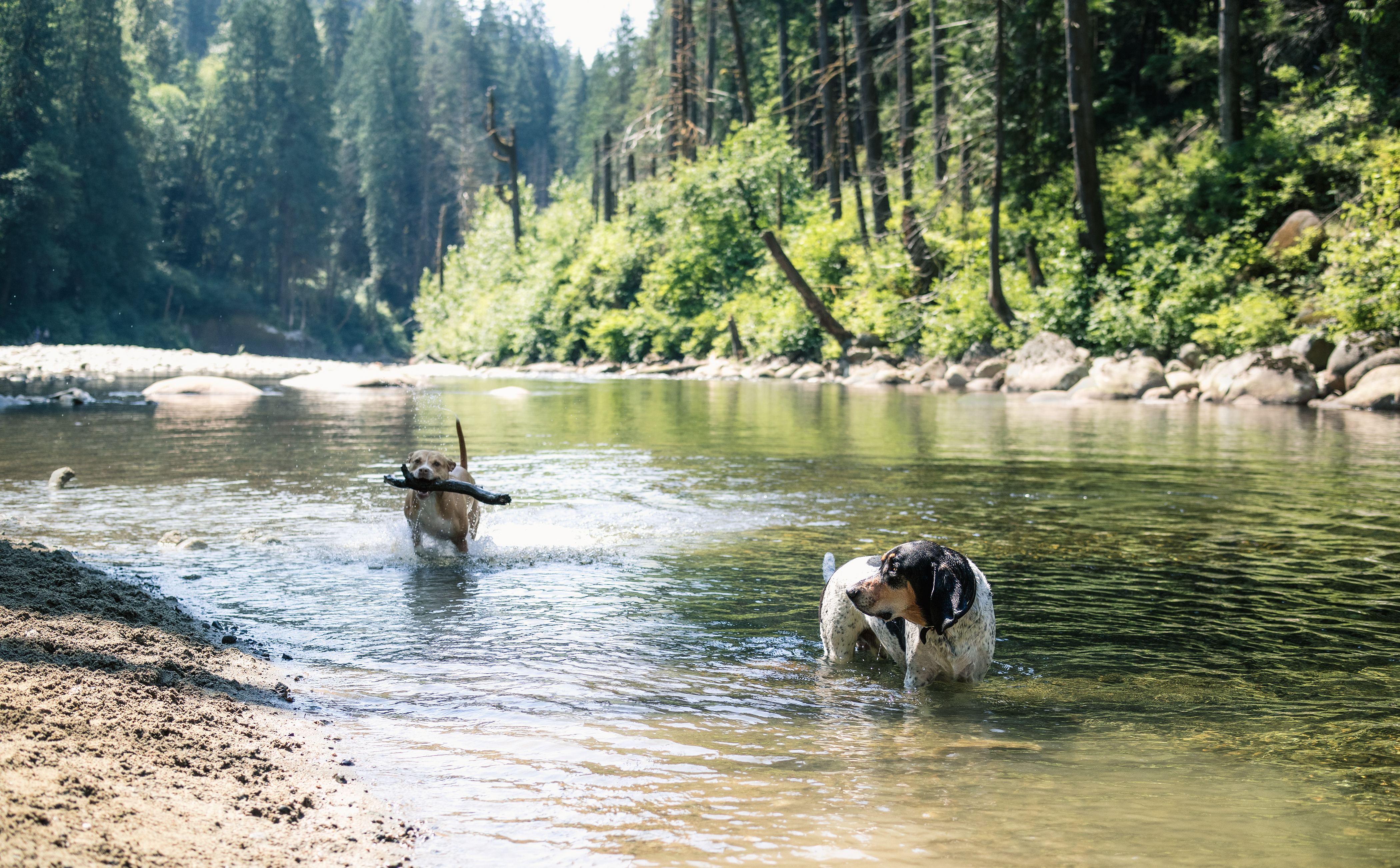
For so many dogs, water is simply irresistible. A lake, a river, or the Puget Sound beach can look like the perfect place to run, cool off, and burn some of that stored-up energy. Sometimes, it’s exactly that… a perfect place to play.
From what we see at MyPets Veterinary Urgent Care & Wellness, the question of whether a dog can safely swim in Washington’s waters is complicated. The big issues here are what’s in the water and what could your dog drink, lick off their coat, or pick up along the shoreline that could be harmful to them.
Water Can Look Fine and Still Pose a Problem
One thing we try to emphasize with dog owners when we talk to them about water safety is the fact that how water looks is only part of the picture. The Washington Department of Ecology recommends staying away from water with obvious signs of things like foam, scum, thick mats, unusual green or reddish-brown coloring, or a paint-like appearance. Those are all very useful visual warnings to keep an eye out for, but they are not a guarantee of your pet’s safety.
Some harmful algal blooms aren’t obvious from shore, and laboratory testing is the only way to confirm whether an algal bloom or mat is toxic. That’s one reason we put more weight on current advisories than on a quick visual inspection. A lake can look perfectly pristine and still have a water-quality warning in effect.
This is especially important with cyanobacteria, sometimes called blue-green algae. The Washington State Department of Health warns that animals can become extremely ill and die after swallowing water contaminated with toxic cyanobacteria. The state has also reported that the number of reports suggesting algal toxins contributed to dog deaths has increased over the past decade.
That is a sobering statistic. It also helps explain why we don’t use the fact that someone has been to that lake before and it was fine as a particularly useful safety check. One thing is certain: conditions in a body of water are constantly changing.
Dogs Can Be Exposed in Many Ways
Your dog does not experience a swimming outing in the same way you do. You might not drink the water while swimming, but they will typically drink it… sometimes quite a lot of it. Once they’re back on shore, they groom themselves and lick their fur and paws. So even a dog that doesn’t swallow much water while swimming can still be exposed to toxins afterward.
King County specifically notes that dogs often drink more lake water than people and can therefore be more likely to get sick when a beach is affected by bacteria or toxic algae. Washington and federal health guidance also identifies licking contaminated material from fur as a potential exposure route.
We’ve found that this is actually one of the easier details for people to overlook. A dog doesn’t necessarily have to plunge into a visibly contaminated patch of water. Drinking, wading, licking, or investigating something along the shoreline can all change the risk equation. With some cyanotoxins, there really isn’t much room for a wait-and-see approach. Washington State Department of Health guidance says symptoms, and in some cases death, can occur within minutes, or up to a few hours, after exposure.
Freshwater Has Risks Far Beyond Algae
Harmful algal blooms tend to get the most attention, but they aren’t the only concern. Leptospirosis is another reason we are cautious about dogs drinking from lakes, streams, puddles, and any slow-moving water. The disease can spread through water or mud contaminated with urine from infected animals, including wildlife. The Washington State Department of Health says canine leptospirosis is regularly diagnosed in dogs in the state. Anything that is regularly diagnosed is something we pay attention to.
There’s some historical local data that puts that concern into perspective. King County documented 110 confirmed or probable canine leptospirosis cases between 2004 and 2008, including 37 fatalities. That isn’t a reason to assume every puddle is dangerous, but it’s a solid reason to remember that natural water is an ecosystem, not a swimming pool.
The CDC also identifies stagnant or slow-moving water such as ponds, rivers, lakes, and streams as potential sources of exposure. From our perspective, that makes the choice of where a dog drinks just as relevant as where they swim.
Puget Sound Isn’t the Automatic Safer Option
It’s tempting to think of saltwater as the safe alternative when a lake has an advisory; however, Puget Sound comes with its own set of issues. Marine biotoxins are one of them. Washington routinely tests shellfish for toxins including Paralytic Shellfish Poison, Amnesic Shellfish Poison, and Diarrhetic Shellfish Poison. The state also maintains a shellfish safety map and a 24-hour hotline at 1-800-562-5632 so people can check current closure information.
The numbers from 2024 are worth paying attention to, however. Shellfish from Madrona Beach, South Elger Bay, and Penn Cove tested above 270 micrograms of Paralytic Shellfish Poison per 100 grams of tissue. Washington’s closure action level is 80 micrograms per 100 grams. Those figures concern shellfish harvesting rather than swimming itself, but they still matter when your dog is exploring tidal areas. A curious dog may eat shellfish, crab remains, or other marine life washed onto the beach. What is a recreational beach to us can be a buffet of questionable items for your dog.
There’s another marine-mammal issue to consider. NOAA Fisheries has advised people to stay at least 100 yards from seals and other marine mammals and to keep dogs leashed and away from them. Washington harbor seals were among the animals that tested positive for H5N1 during recent wildlife disease events. The general public risk was described as low when contact is avoided. That’s the important part to remember. You should try to avoid contact.
Beach Closures Are Worth Taking Literally
We sometimes see people treat a posted closure as a recommendation rather than a boundary. For dogs, we’d strongly advise against that. King County’s guidance is unusually direct. When a beach is closed because of high bacteria or toxic algae, it isn’t safe for people or pets. The county also advises against taking dogs to public swimming beaches.
Washington State Parks has its own rules. Pets must be physically controlled on a leash no longer than eight feet in state park areas, and pets aren’t permitted to go on designated swimming beaches. Other locations have additional restrictions. Some rivers and natural areas prohibit swimming or pets entirely. So before heading out, checking the rules for the specific location is a big part of water safety. It’s not just some administrative detail to deal with after you arrive.
What to Know Before Letting Your Dog Near Washington’s Waters
Our practical approach is fairly simple.
Before planning a swimming or beach outing, we would check the current local advisory for that body of water. Washington Department of Ecology’s swimming information, county public-health alerts, and the state’s shellfish safety resources can all provide information that isn’t visible from the shoreline.
Next, look at the water itself. If there’s visible algae, scum, foam, an unusual color, or a warning sign, don’t let your dog enter.
Keep dogs away from dead fish, birds, seals, and other mammals. Close contact can expose both animals to infectious diseases. Don’t let them eat things they find along the shore, particularly shellfish or animal remains.
Remember to bring along fresh drinking water for your pet. That might sound too simple, but giving your dog an alternative to lake or river water removes one of the most straightforward exposure routes.
If a dog does get into water that’s under an advisory or develops vomiting, diarrhea, weakness, difficulty breathing, tremors, seizures, or unusual lethargy afterward, we would treat that seriously and contact a veterinarian promptly.
When it comes to suspected cyanotoxin exposure, waiting for symptoms to become serious can be dangerous because deterioration may happen quickly.
A Good Swim Starts Before Your Dog Gets Wet
You don’t need to keep your dog away from every lake, river, or beach in Washington. That would be missing a lot of the fun of having a pet. The better lesson here is that natural water should not be misconstrued as just one category. Conditions vary from lake to lake, beach to beach, and even from one week to the next. Heavy rain can affect bacteria levels. Shellfish closures can always change. Wildlife disease events can introduce another reason to keep some distance. This means even your familiar swimming spot can develop an algae problem.
For us, safe swimming is more about making a habit of checking a few things before your dog jumps in.
- If there is an advisory, stay out.
- If the water looks suspicious, stay out.
- If your dog is determined to investigate something questionable on the shoreline, redirect them.
This might mean skipping a swim once in a while, but that’s a much easier tradeoff than dealing with an emergency after what was supposed to be an ordinary afternoon outside. If something unexpected does happen, we are available 24/7 for urgent and emergency care when your pet needs it most.